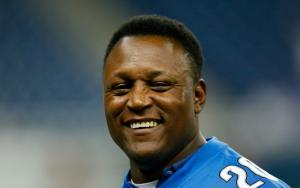
Barry Sanders is a retired American football running back who played ten seasons with the Detroit Lions in the National Football League (NFL). Known for his extraordinary quickness and agility, Sanders led the NFL in rushing yards four times and was selected to the Pro Bowl in each of his ten seasons. He earned the NFL Offensive Player of the Year award twice and remains widely regarded as one of the best running backs in NFL history. In 2007, the NFL Network ranked him the most elusive runner in NFL history on its "NFL Top 10" series. He was also listed as the greatest short player of all time and ranked number one among players who never appeared in a Super Bowl.
Sanders played college football for the Oklahoma State Cowboys from 1986 to 1988. Initially backing up All-American Thurman Thomas, he took over the starting role in 1988 and delivered one of the greatest seasons in college football history. That year, he rushed for an NCAA-record 2,850 yards and scored 42 touchdowns in just 12 games. His extraordinary performance earned him the Heisman Trophy and unanimous All-American honors. Sanders was inducted into the Kansas Sports Hall of Fame in 1998, and later honored by both the College Football Hall of Fame and the Michigan Sports Hall of Fame in 2003.
Barry Sanders was born on July 16, 1968, in Wichita, Kansas, to William Sanders, a carpenter, and Shirley Sanders, a nurse. He was part of a large family with ten siblings—two brothers and eight sisters.
Sanders attended Wichita North High School, where his football talent began to emerge. Despite earning all-state honors, his smaller stature limited his recruitment opportunities. He ultimately received scholarship offers from Tulsa, Emporia State, and Oklahoma State University, choosing the latter to pursue his football career.
Selected third overall in the 1989 NFL Draft by the Detroit Lions, Sanders inherited the number 20 jersey, previously worn by notable Lions players like Billy Sims and Lem Barney. While Sanders was a running back—not a quarterback, as sometimes misstated—he was the centerpiece of Detroit's offense throughout the 1990s. The team reached the playoffs five times during his tenure, including two NFC Central Division championships in 1991 and 1993.
In 1994, Sanders was named NFL Offensive Player of the Year after rushing for 1,883 yards. He set a new career-high in total yardage the next year with 1,500 rushing yards and 398 receiving yards. However, in 1996, he recorded a career-low 147 receiving yards.
His most remarkable season came in 1997, when he became only the third player in NFL history to rush for over 2,000 yards in a single season, joining O.J. Simpson and Eric Dickerson. That year, he joined the exclusive “2,000 rushing yards club” and became the first player to rush for at least 1,500 yards in five different seasons, including four consecutively.
Sanders played his final NFL season in 1998, narrowly missing the 1,500-yard mark with 1,491 rushing yards. In 1999, he announced his unexpected and controversial retirement from professional football, citing the Lions' lack of success as a contributing factor. At the time of his retirement, he had accumulated 15,269 rushing yards, 2,921 receiving yards, and 109 touchdowns (99 rushing and 10 receiving).
In 2000, Sanders married television personality Lauren Campbell. The couple had three sons—Nigel, Nicholas, and Noah—before divorcing in 2012.
Sanders also has a son from a previous relationship, Barry J. Sanders. Following in his father's athletic footsteps, Barry J. enrolled at Stanford University for the 2012–2013 college football season, pursuing his own career in the sport.
| Birth Date: | 16 Jul, 1968 |
| Age: | 51 yrs |
| Occupations: | American football player |
| Citizenship: | United States of America |
| Birth Place: | Wichita |
| Education: | Wichita North High School |
| Gender: | Male |
| Description: | American football running back, Pro Football Hall of Famer |
| Twitter Id: | BarrySanders |
| Net Worth 2021: | 20 million |