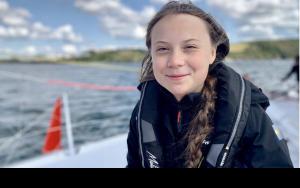
Greta Thunberg is a Swedish environmental activist internationally recognized for urging world leaders to take immediate and substantial action to combat climate change. She rose to global prominence in 2018 through her school strike for climate outside the Swedish Parliament.
Thunberg was born on January 3, 2003, in Stockholm, Sweden. Her mother, Malena Ernman, is a well-known opera singer who represented Sweden in the Eurovision Song Contest in 2009. Her father, Svante Thunberg, is an actor, and Greta is distantly related to Svante Arrhenius, a Nobel Prize-winning chemist who was an early pioneer in studying the greenhouse effect.
Greta's younger sister, Beata, is also musically inclined and known within Sweden. Both siblings have been open about living with neurodevelopmental conditions such as ADHD and OCD. Greta has Asperger's syndrome, a form of autism spectrum disorder, which she refers to as her “superpower.”
Greta became aware of climate change at the age of eight, and the perceived lack of action deeply affected her, eventually leading to severe depression. Restricting her eating and becoming withdrawn, Greta struggled with a condition known as selective mutism, where she would speak only when she felt it was truly necessary. Discussing environmental issues became a way for her to find her voice again.
Her activism initially focused on influencing her family. Her parents recall her determination and strong grasp of scientific data, often armed with charts and statistics. Over time, her persistence led her parents to make more environmentally conscious choices, including reducing air travel and changing their diets. Greta described the transformation of her family’s lifestyle as one of her early successes, giving her confidence to pursue wider advocacy.
Although Greta's parents were not originally involved in climate activism, Greta pursued the subject independently. In May 2018, at age 15, she won an essay competition on climate change in a Swedish newspaper. Soon after, she attended a meeting with Fossil Free Dalsland, an environmental group. Inspired by student protests following the Parkland, Florida school shooting in the U.S., she envisioned her own form of protest—refusing school attendance in response to political inaction on climate change.
In August 2018, Greta began her solo protest in front of the Swedish Parliament, demanding the government align with carbon emissions targets consistent with the Paris Agreement. Holding a sign reading "Skolstrejk för klimatet" (School Strike for Climate), she pledged to strike every Friday until more serious action was taken.
Although her classmates initially did not join her, Greta’s protest gained traction online. She continued to attend school on other days and maintained high academic performance, reportedly ranking among the top of her class despite her activism commitments.
Her movement, now known globally as #FridaysForFuture, began to spread across continents. By December 2018, over 20,000 students in countries including Australia, the UK, Belgium, the U.S., and Japan had joined similar school strikes.