Thomas Jefferson
Edit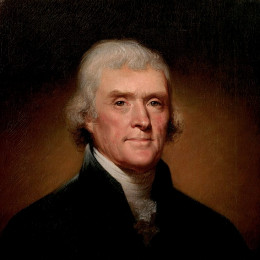 Enlarge Image
Thomas Jefferson (April 13, 1743 – July 4, 1826) was an American statesman, diplomat, lawyer, architect, musician, philosopher, and Founding Father who served as the third president of the United States from 1801 to 1809. Prior to his presidency, he served as the second vice president (1797–1801) under John Adams and as the first secretary of state (1790–1793) under President George Washington. Jefferson was the principal author of the Declaration of Independence and a leading advocate for democracy, republicanism, and individual rights—principles that inspired American colonists to pursue independence from Great Britain and establish a new nation. His contributions to legislation and governance at both the state and federal levels greatly shaped early American political identity.
Explore Related Biographies
Selected for this profile


Background and Early Life
Thomas Jefferson was born on April 13, 1743, at Shadwell Plantation in the Colony of Virginia. He was the third of ten children and of English, and possibly Welsh, ancestry. His father, Peter Jefferson, was a landowner and a self-educated surveyor, and his mother, Jane Randolph, belonged to the prominent and affluent Randolph family. When the plantation's original owner and family friend, William Randolph III, passed away, Peter Jefferson—whom Randolph named as the children's guardian—moved his family to manage Tuckahoe Plantation in 1745. The Jeffersons returned to Shadwell in 1752, and upon Peter's death in 1757, Thomas and his younger brother Randolph inherited the estate. Jefferson gained full control of his 5,000-acre inheritance, which included Monticello, when he turned 21.
His formal education began at age five in an English school and continued under the instruction of a Scottish Presbyterian minister when he was nine. During his early schooling, Jefferson developed a keen interest in the natural world, began studying Latin, Greek, and French, and learned horseback riding. He also read extensively from his father's personal library. From 1758 to 1760, Jefferson studied under Reverend James Maury near Gordonsville, Virginia, focusing on history, the sciences, and classical studies. During this time, he was exposed to various cultural influences, including frequent interactions with Native American visitors, such as the Cherokee chief Ontasseté. He also visited Williamsburg, where he was hosted by Colonel John Dandridge, and met figures like Patrick Henry, with whom he shared a passion for music.
Education and Intellectual Influences
At age 16, Jefferson enrolled at the College of William & Mary in Williamsburg, where he studied mathematics, metaphysics, and philosophy under Professor William Small. Small introduced him to Enlightenment thinkers, particularly John Locke, Francis Bacon, and Isaac Newton. Through Small, Jefferson also became acquainted with George Wythe and Governor Francis Fauquier, both of whom significantly influenced his intellectual development. Jefferson credited these sessions—often Friday dinner discussions—with shaping his political and philosophical outlook.
Although initially distracted by social life and entertainment, by his second year Jefferson became dedicated to his studies, sometimes spending up to fifteen hours a day reading and studying. During this period, he refined his fluency in French and Greek and advanced his skill on the violin. After completing his college coursework in 1762, Jefferson studied law under George Wythe, one of the foremost legal minds in Virginia. Under Wythe’s mentorship, he became an avid scholar of English law, political theory, and classical literature. He also compiled a comprehensive Commonplace Book of notes, excerpts, and thoughts on ethical philosophy, law, and governance. Wythe would later bequeath his entire personal library to Jefferson, a testament to their enduring intellectual bond.
The Declaration of Independence
Jefferson is best known as the primary author of the Declaration of Independence. Even before George Washington took office as the first president, Jefferson had been articulating political philosophies that promoted liberty and self-governance. At the beginning of the Revolutionary War in 1775, Jefferson was among the youngest delegates to join the Second Continental Congress, where a movement to formally declare independence from Britain gained momentum.
In 1776, in response to the passage of the Lee Resolution by Congress, a Committee of Five was assembled to draft a declaration. Although John Adams was initially expected to write the document, he instead urged Jefferson to take the lead, recognizing his eloquence and deep understanding of political theory. Jefferson began drafting the Declaration in mid-June, drawing from his previously written Virginia Constitution, the Virginia Declaration of Rights by George Mason, and Enlightenment principles—especially those articulated by Locke and Montesquieu focusing on natural rights and social contract theory.
Over the next seventeen days, Jefferson consulted with the other committee members, including Adams and Benjamin Franklin, while revising the text. On June 28, 1776, a final draft was submitted to Congress. After debate, Congress removed about a quarter of Jefferson’s original text, including a passage critical of King George III’s role in perpetuating slavery. Although Jefferson was disappointed by the redactions, he did not openly protest them.
The Declaration was adopted on July 4, 1776, and formally signed on August 2, marking a defining moment in world history. The phrase “all men are created equal,” crafted by Jefferson in the preamble, has since become one of the most enduring and impactful statements in the American political lexicon, underpinning the nation's ongoing struggle for liberty and equality.