Woody Guthrie
Edit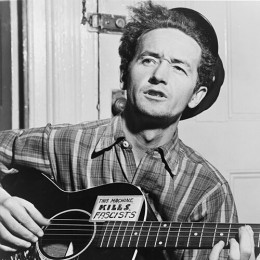 Enlarge Image
Woody Guthrie was an American folk singer, songwriter, writer and visual artist whose work drew on migration, labour and everyday life. Best known for “This Land Is Your Land,” he wrote topical songs, children's music and accounts of the Dust Bowl. His influence reached later performers including Bob Dylan, while his recordings and manuscripts became important archival collections.
Explore Related Biographies
Selected for this profile


People Mentioned in This Biography
Early life in Oklahoma and Texas
Born Woodrow Wilson Guthrie on July 14, 1912, in Okemah, Oklahoma, he grew up hearing music at home and witnessing the unstable fortunes of an oil-boom town. The official Guthrie biography traces his move to Pampa, Texas, in 1931 and the early bands through which he began performing. Drawing, painting and sign work were also part of his developing creative life.
The Dust Bowl and the Great Depression became central experiences behind his songs. As the Woody Guthrie Center explains, the storms he witnessed in the Texas Panhandle helped inspire “So Long, It's Been Good to Know Yuh.” Travelling west exposed him to the lives of people searching for work, giving his writing subjects that extended beyond his own circumstances.
California radio and Dust Bowl Ballads
In Los Angeles, Guthrie found an audience on KFVD radio, singing with Maxine Crissman, known as Lefty Lou. Their programme reached migrants who recognized the places, experiences and language in the music. Songs such as “Do Re Mi” and “I Ain't Got No Home” addressed the gap between the promise of a better life and the difficulties faced by people arriving in California.
His first album, Dust Bowl Ballads, was recorded in 1940. Smithsonian Folkways' album account identifies it as a record of the Dust Bowl in his talking-blues style and notes its later reissue in 1950. The recordings brought together storytelling, social observation and performance rather than treating hardship as an abstract subject.
This Land Is Your Land
Guthrie wrote “This Land Is Your Land” in February 1940. The Library of Congress history of the song explains that it responded to Irving Berlin's “God Bless America.” Guthrie first recorded it in 1944. Its broad familiarity can obscure the questions about belonging and inequality that accompanied its celebration of the American landscape.
New York, Folkways and writing
In New York, Guthrie worked among musicians including Pete Seeger, Lead Belly and Cisco Houston. Smithsonian Folkways' artist history documents his participation in the Almanac Singers and his extensive recording relationship with Moses Asch. That body of work included traditional material, protest songs and songs for children.
His creative output also extended to the autobiographical novel Bound for Glory, drawings and other prose. Many of his compositions survived as written lyrics rather than recordings. The distinction matters when considering the scale of his work: the familiar released songs represent only part of a much larger archive of ideas, stories and images.
Later life, death and influence
Huntington's disease increasingly limited Guthrie's ability to work and led to long periods in hospital. Younger folk musicians, including Dylan, visited him during those years. He died on October 3, 1967, at age 55. His official biography identifies Creedmoor State Hospital in Queens, New York, as the place of his death.
The Rock & Roll Hall of Fame inducted him in 1988, recognizing the influence of his songwriting beyond the folk tradition. The Woody Guthrie Center in Tulsa preserves notebooks, correspondence and other materials that allow his career to be studied alongside the songs. His continuing importance rests both on that body of work and on the example of a songwriter responding directly to the world around him.
Portrait: Al Aumuller / New York World-Telegram & Sun. March 8, 1943. Public domain; no known restrictions on publication for NYWT&S staff photographs. Resized Commons preview, converted from grayscale to RGB for upload, and automatic site thumbnail crop; no retouching. Original Commons file page; Public domain; no known restrictions on publication for NYWT&S staff photographs.