Bing Crosby
Edit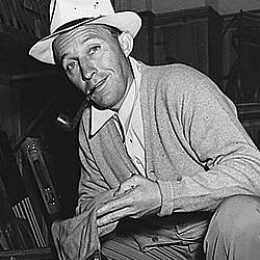 Enlarge Image
Bing Crosby was an American singer, actor and broadcaster whose relaxed vocal style became familiar through records, radio, films and television. His work ranged from popular songs and Christmas recordings to musical comedy and dramatic acting. He won an Academy Award for Going My Way and became closely associated with Irving Berlin’s “White Christmas.”
Explore Related Biographies
Selected for this profile
People Mentioned in This Biography

Early life and Gonzaga education
Born Harry Lillis Crosby on May 3, 1903, in Tacoma, Washington, he grew up in Spokane. According to Gonzaga University’s account, his nickname developed from a childhood friend’s reference to “The Bingville Bugle,” a comic feature the boys enjoyed.
Crosby graduated from Gonzaga High School in 1920 and entered Gonzaga University that autumn intending to pursue law. Music increasingly occupied his time: he played drums and joined the Musicaladers, a local dance band. He eventually left his studies to concentrate on performing, without completing a degree. Gonzaga later awarded him an honorary degree in 1937.
Al Rinker, Paul Whiteman and the Rhythm Boys
In 1925, Crosby traveled to Los Angeles with pianist and singer Al Rinker. The university’s early-career history follows their move from local entertainment into professional engagements on the West Coast.
The pair joined Paul Whiteman’s orchestra in 1926. With pianist and songwriter Harry Barris, they formed the Rhythm Boys. Singing with a prominent touring orchestra gave Crosby experience and exposure before he established a separate career as a recording artist and radio performer.
Records, radio and a conversational voice
By the early 1930s, Crosby was finding success with solo recordings and broadcasts. Songs such as “I Surrender, Dear” and “Where the Blue of the Night” helped establish his identity outside the Rhythm Boys. His recorded repertoire eventually included romantic ballads, jazz-influenced performances, popular standards and holiday music.
Biographer Gary Giddins’s American Masters essay describes how Crosby used the microphone to communicate small changes in feeling and musical phrasing. His easy delivery also suited radio conversation. As host of Kraft Music Hall, he combined singing, comedy and appearances by other performers in a program built around his unhurried personality.
Going My Way and screen comedy
Crosby’s screen career included the Road comedies with Bob Hope and the role of Father Chuck O’Malley in Going My Way (1944). The Academy’s 1945 ceremony record identifies Crosby as the Best Actor winner for that film. He returned to the character in The Bells of St. Mary’s.
He also appeared in films that placed his singing alongside contrasting kinds of performance. The Country Girl gave him a dramatic role, while High Society brought him into a musical ensemble with Grace Kelly, Frank Sinatra and Louis Armstrong. These productions extended his screen identity beyond the amiable singer familiar from radio.
White Christmas and later television work
Crosby sang Berlin’s “White Christmas” in Holiday Inn (1942). The song’s Academy Award, presented in 1943, went to its songwriter, Berlin. Crosby later starred in White Christmas (1954), whose cast included Rosemary Clooney. The two films are separate productions connected by the song.
The American Masters career timeline records his continuing work in films and television. His later appearances included variety specials and Christmas programs; a final holiday television production in 1977 included David Bowie.
Tape recording and legacy
Crosby also helped bring magnetic tape into American broadcasting. The Computer History Museum describes engineer John T. Mullin’s work with Crosby and Ampex engineer Harold Lindsay on the commercial Model 200 recorder, introduced in 1948. Crosby’s support and use of the technology helped performers record and edit programs before transmission.
He died on October 14, 1977, near Madrid, Spain. Gonzaga’s Crosby House Museum preserves material from his career, including his Oscar, connecting his international entertainment career with the Spokane community where he grew up.
Portrait credit
Franklin D. Roosevelt Library / National Archives, NAID 195573, June 15, 1942; individual photographer uncredited. Wikimedia Commons source; public-domain U.S. government photograph. Existing crop by Voceditenore; resized Commons preview; no additional retouching. The site may resize or crop the portrait for display.